By Dr. Humberto Fernandez Miro, MD
Medical Contributor, WeightLossPills.com
Every week, I have a conversation that goes something like this: a patient — a woman in her late thirties or forties — tells me her husband started semaglutide the same month she did, at similar doses, and he has lost nearly twice as much weight. She is doing everything right. She is not cheating. She is frustrated, and honestly, she has every reason to be.
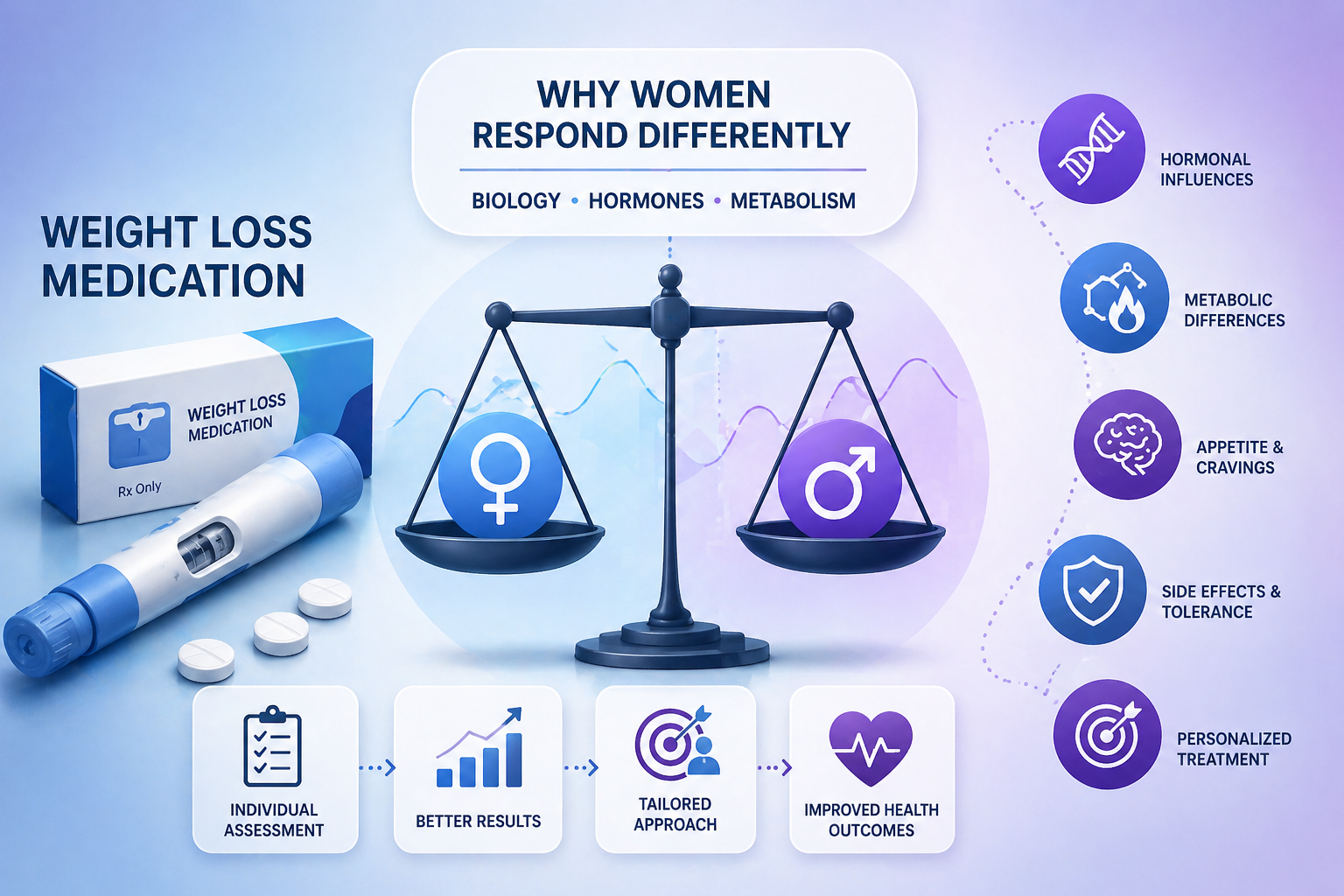
This is not an anecdote. It is a pattern I see consistently in clinical practice, and the biology behind it is real, even if it is still underappreciated in how we design treatment protocols for women.
The Hormonal Landscape Is Not Neutral
When we talk about weight loss medications — GLP-1 receptor agonists like semaglutide and tirzepatide in particular — we are talking about drugs that work through appetite suppression, slowed gastric emptying, and modulation of reward signaling around food. None of those pathways operate in a vacuum, and in women, they are embedded in a hormonal environment that changes week to week, decade to decade.
Estrogen has direct effects on GLP-1 receptor expression. It modulates how sensitive certain brain regions are to satiety signals, and it influences fat distribution in ways that interact with how the body responds to caloric restriction. During the luteal phase of the menstrual cycle — roughly the two weeks before menstruation — progesterone rises and drives up both appetite and caloric intake. For many of my patients, this is the week the medication feels like it stops working. It has not stopped working. Their underlying hormonal milieu is just pushing harder in the opposite direction.
Cortisol adds another layer. Women who are chronically sleep-deprived, managing high stress loads, or dealing with autoimmune conditions tend to have dysregulated cortisol patterns that promote central adiposity and blunt the metabolic response to GLP-1 therapy. This is not a character flaw. It is physiology, and it matters for treatment planning.
Why GLP-1s Sometimes Work More Slowly in Women
The clinical trial data for semaglutide and tirzepatide does show robust weight loss in women — I want to be clear about that. But the trajectory is often different. Men tend to see sharper early losses; women’s weight loss is sometimes more gradual, with a flatter curve in the first several months before catching up. A few things drive this.
First, baseline body composition. Women carry a higher percentage of body fat relative to lean mass than men of equivalent weight, and fat tissue is metabolically different from muscle. The initial rapid weight loss that many men experience on GLP-1s is partly driven by loss of lean mass and water — women tend to lose proportionally less lean mass, which is actually better for long-term metabolic health, but it makes the scale move more slowly in the early months.
Second, there is emerging evidence that estrogen may partially attenuate the nausea-driven appetite suppression that GLP-1 agonists produce. Some women tolerate these medications more easily — they do not feel as sick — which sounds like good news, but it can mean less suppression of appetite at equivalent doses.
Third, thyroid function. Subclinical hypothyroidism is significantly more common in women than men, and even mildly suboptimal thyroid function can slow the metabolic response to any weight loss intervention. I routinely screen for this before titrating GLP-1 doses in female patients who are not seeing expected responses.
How I Adjust Treatment for Women
One thing I do differently for women is take a detailed menstrual history before we interpret progress. If a patient is weighing herself during the luteal phase, she may be carrying three to five pounds of fluid retention that has nothing to do with adipose tissue. I ask patients to track their weight on day two or three of their cycle, or — if they are post-menopausal or on hormonal contraception — to pick a consistent time and day and to not weigh themselves every day. The daily variation creates unnecessary anxiety.
For women who are peri-menopausal, the conversation gets more complex. The estrogen drop that begins in perimenopause shifts fat distribution toward the abdomen, increases insulin resistance, and coincides with sleep disruption that elevates cortisol. This is often when women who have maintained a stable weight for decades find themselves gaining despite no change in behavior. GLP-1 therapy can be very effective in this window, but I pair it with attention to sleep hygiene, stress load, and in some cases, a conversation with their gynecologist about whether menopausal hormone therapy might also be appropriate.
Dosing schedules also warrant more individualized thinking in women. The standard weekly titration protocol was largely developed in mixed-sex or male-predominant populations. I have patients who do better on slower titration — staying at a lower dose longer before moving up — particularly those who are sensitive to nausea or who have a history of disordered eating. There is no shame in spending twelve weeks at a lower dose if it is the dose you can actually tolerate and sustain.
What Women Should Advocate For
If you are a woman navigating a conversation with your physician about weight loss medication — whether you are researching the best weight loss pills for women or already mid-treatment — there are a few things worth raising explicitly.
Ask your doctor to look at your thyroid panel, not just a TSH but a full panel including free T4, if you are not seeing results you expect. Ask about how your menstrual cycle might be affecting both your appetite and your weight measurements. If you are peri-menopausal and gaining weight rapidly, ask whether hormonal changes are contributing and whether any intervention on that front might support your treatment.
Push back gently but firmly if your progress is being compared to population averages without accounting for sex-specific factors. The average hides enormous variance. A woman losing 1.5 pounds a month on semaglutide while managing luteal phase appetite spikes, subclinical hypothyroidism, and a stressful job is not failing treatment. She is doing exceptionally well under real physiological conditions.
Also, ask about combination approaches. GLP-1 therapy is powerful, but in women with significant hormonal drivers of weight gain, it works best as part of a broader plan that includes metabolic monitoring, attention to sleep and cortisol, and sometimes coordination with endocrinology or gynecology. This is not because your case is complicated in a bad way. It is because your physiology is complex in a real way, and you deserve care that reflects that.
The Bigger Picture
Obesity medicine has historically been developed with a bias toward male physiology — not through malice, but through the legacy of clinical trial enrollment patterns and a tendency to treat sex as a covariate to control rather than a dimension to understand. That is changing, slowly, and the GLP-1 era has actually accelerated some of that work because the sex differences in response are too obvious to ignore.
What I tell my patients is this: your body is not a broken version of the average trial participant. It is a specific, hormonally complex system, and understanding how it responds to treatment is not an excuse — it is information. The more precisely we can characterize why a given woman responds the way she does, the better we can tailor treatment to actually work for her. That is the direction this field is moving, and it is long overdue.
Dr. Humberto Fernandez Miro, MD, is a board-certified physician and medical contributor at WeightLossPills.com, where he specializes in obesity medicine, GLP-1 therapy, and metabolic health.
