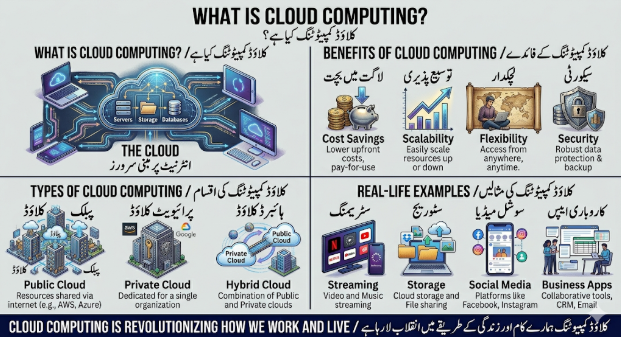
Cloud computing has become one of the most important technologies in today’s digital world. From storing photos on your phone to running large business systems online, cloud computing is everywhere. In simple terms, it allows users to access computing resources like storage, servers, databases, and software over the internet instead of using a local computer or physical device.
Today, businesses, governments, and individuals all rely on cloud computing because it is flexible, cost-effective, and highly scalable.
What is Cloud Computing?
Cloud computing is a technology that delivers computing services over the internet. These services include data storage, servers, networking, databases, software, and analytics.
Instead of saving files on a personal computer or running programs from a local server, what is cloud computing allows you to access everything through the internet from anywhere in the world. .
For example, when you use Google Drive, Dropbox, or Microsoft OneDrive, you are already using cloud computing without even realizing it.
The main idea behind cloud computing is “on-demand access”—you only use what you need, and you can scale up or down anytime.
How Cloud Computing Works
Cloud computing works through a network of remote servers hosted on the internet. These servers store, manage, and process data instead of your local device.
When you upload a file, stream a video, or use an online application, your request goes to these cloud servers. The servers process the request and send the result back to your device almost instantly.
This system is supported by large data centers located around the world, which ensure speed, security, and reliability.
Types of Cloud Computing
Cloud computing is divided into different types based on services and deployment methods.
1. Infrastructure as a Service (IaaS)
This is the most basic level of cloud computing. It provides virtualized computing resources such as servers and storage over the internet. Businesses use IaaS to avoid buying expensive physical hardware.
2. Platform as a Service (PaaS)
PaaS provides a platform where developers can build, test, and deploy applications without worrying about managing infrastructure. It simplifies the development process.
3. Software as a Service (SaaS)
SaaS delivers software applications over the internet. Users do not need to install anything; they simply access the software through a browser. Examples include Gmail, Zoom, and Microsoft Office 365.
Deployment Models of Cloud Computing
Cloud computing also has different deployment models depending on usage needs.
Public Cloud
Services are offered over the public internet and shared between multiple users in technology It is cost-effective and widely used by individuals and businesses
Private Cloud
This is dedicated to a single organization. It offers more security and control, making it suitable for large companies and sensitive data.
Hybrid Cloud
Hybrid cloud combines both public and private clouds. It allows data and applications to be shared between them for more flexibility.
Benefits of Cloud Computing
Cloud computing offers many advantages that make it popular worldwide.
One of the biggest benefits is cost savings. Businesses do not need to invest in expensive hardware or maintenance. They only pay for what they use.
Another major benefit is flexibility. Users can access data and applications from anywhere using an internet connection.
It also provides scalability. Companies can easily increase or decrease resources based on demand without any technical difficulty.
Cloud computing also improves collaboration. Teams can work together on the same documents or projects in real time, no matter where they are located.
Security is another important benefit. Most cloud providers use advanced security systems, encryption, and backup solutions to protect data.
Real-Life Examples of Cloud Computing
Cloud computing is used in many everyday applications.
Streaming platforms like Netflix and YouTube use cloud servers to deliver videos to millions of users worldwide without interruption.
Social media platforms like Instagram and Facebook store massive amounts of user data in the cloud.
Online storage services such as Google Drive allow users to save and access files from any device.
Even online gaming platforms use cloud computing to provide smooth gameplay without requiring powerful local devices.
Businesses also use cloud systems for customer management, data analysis, and communication tools.
Challenges of Cloud Computing
Although cloud computing has many benefits, it also comes with some challenges.
One concern is internet dependency. Without a stable internet connection, users cannot access cloud services.
Data privacy is another issue. Since data is stored on remote servers, some users worry about security and control.
There can also be downtime if cloud servers face technical issues, although this is rare with major providers.
Future of Cloud Computing
The future of cloud computing is very promising. With advancements in artificial intelligence, machine learning, and 5G technology, cloud services will become even faster and smarter.
More businesses are shifting to cloud-based systems to improve efficiency and reduce costs. In the coming years, cloud computing is expected to become the backbone of almost every digital service.
Conclusion
Cloud computing has transformed the way we use technology. It provides easy access to powerful computing resources without the need for physical infrastructure.
From personal storage to large business operations, cloud computing plays a key role in modern life. Its flexibility, scalability, and cost-effectiveness make it one of the most important innovations of the digital age.As technology continues to evolve, cloud computing will become even more essential in shaping the future of the internet and digital services