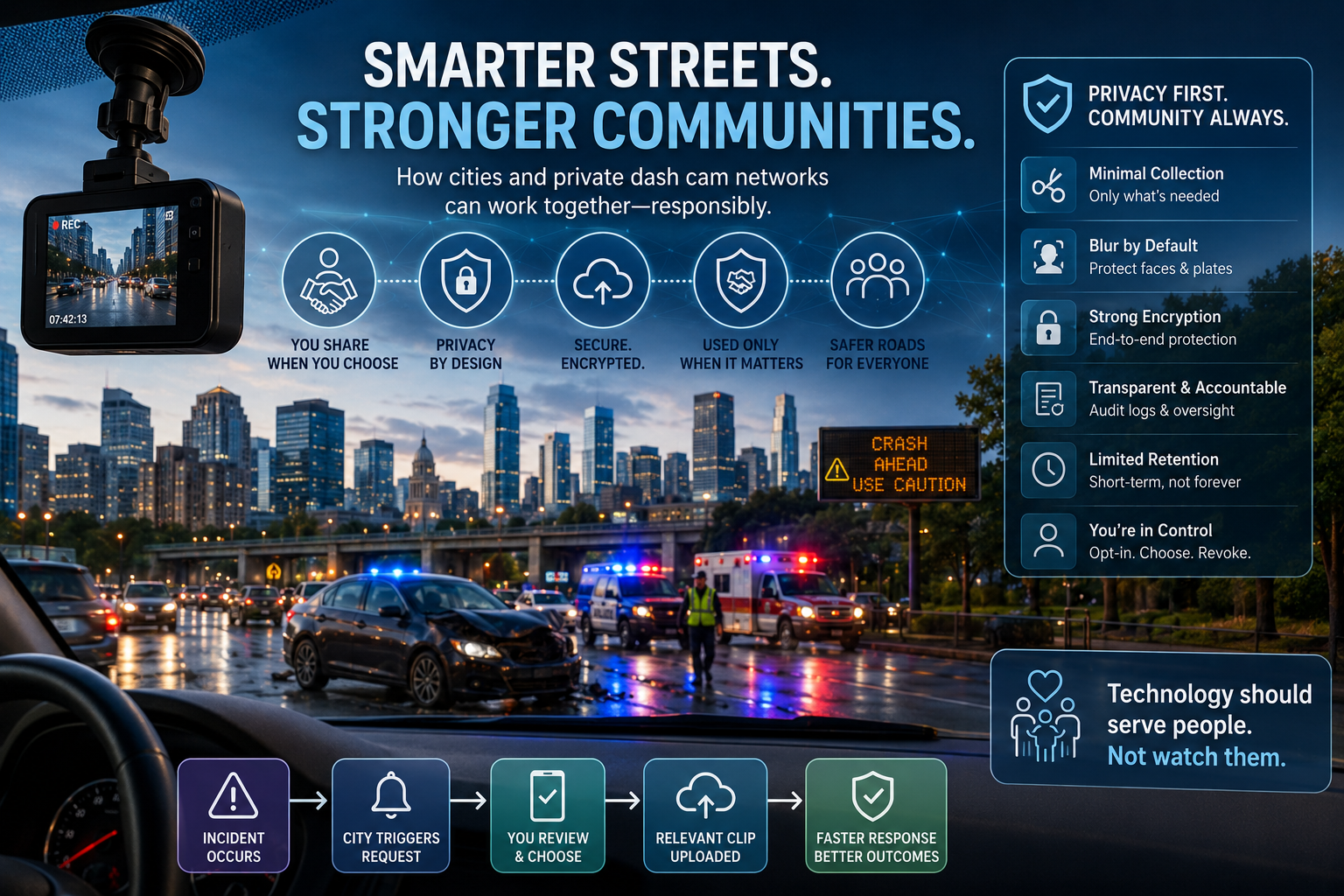
You’ve probably felt it: that little spike of anxiety when you see flashing lights ahead, the sudden slowdown, the rubbernecking, the wondering—*What happened? Is everyone okay?* Cities feel that tension too, just at scale. And in the next decade, many cities will look for faster, more humane ways to respond to crashes, road rage, hit-and-runs, and even missing-person alerts. One powerful—yet delicate—possibility sits quietly on windshields everywhere: privately owned video networks.
If you drive, you already carry a roaming witness. If you walk, ride, or take the bus, you still live inside the same web of streets and near-misses. The big question isn’t whether video can help. You already know it can. The real question is: how can cities work with you—without turning your daily life into a surveillance state?
Below is an informational guide to what this future might look like, and what you should watch for as these systems evolve.
Why Cities Want Your Dash Cam Footage (and Why You Might, Too)
When a crash happens, minutes matter. For emergency response, those minutes can mean the difference between a close call and a tragedy. Cities are hungry for real-time clarity: *What lane is blocked? Is there fire? Are people trapped? Is traffic backing into an intersection that will cause another collision?*
That’s where dash cams could help—if it’s built with consent and restraint.
You might appreciate it in surprisingly personal ways:
– You get quicker clearance of accidents that stall your commute.
– You see fewer “he said, she said” disputes after a dangerous merge.
– You get faster identification of drivers who flee the scene.
– You gain community-level protection during severe weather, protests, or major events—when confusion spreads faster than facts.
Still, it’s not all warm and fuzzy. You’re right to wonder: *Will cities ask nicely—or will they quietly take more than they should?* That question leads straight to how future partnerships may be designed.
The Most Likely Models for City + Dash Camera Collaboration
Cities won’t all choose the same approach. Some will be cautious and privacy-forward. Others will push boundaries. These are the models most likely to appear—and you’ll want to recognize them when they do.
1) Opt-in “Digital Witness” Programs
You voluntarily enroll through a city portal or approved partner app. You decide what you share, when you share it, and whether it’s automatic or manual. The city might request footage in a geofenced area after a reported incident, and you receive a notification: *“Do you want to upload video from 7:42–7:49 p.m. near 4th and Pine?”*
This model treats you like a partner, not a resource to be mined.
2) Time-Limited, Incident-Triggered Upload Requests
Instead of continuous streaming, the city triggers requests only after a verified event—like a 911 call, crash sensor data, or a traffic-management alert. Think “send only what matters.” This reduces creepiness and cuts down on irrelevant collection.
3) Third-Party Clearinghouses
A neutral intermediary (a nonprofit, insurer consortium, or regulated vendor) holds the request system. The city can’t just browse. They must file a request, document the reason, and meet a threshold. You can approve, deny, or require a warrant-backed request depending on the category.
This is where governance becomes real, not performative.
4) Emergency “Amber-Style” Video Queries for Serious Cases
For missing children, active shooter events, or terrorism-level threats, cities may ask for rapid, localized uploads. That’s emotionally compelling—because you can imagine wanting every possible lead if it were your family. But it’s also where safeguards must be strictest, because urgency can become an excuse that never ends.
The Legal and Ethical Tripwires You Should Expect
To understand how messy this gets, it helps to think about one intense word: depose.
Not long ago, during a tense neighborhood dispute, a driver shared a clip from a dash cam showing a near-collision and shouted threats. The video went viral—fast, sloppy, and out of context. Then came the lawsuit, the formal statements, and that moment people rarely picture when they hit “share”: lawyers asking to *depose* witnesses. Suddenly, a casual upload turned into official testimony. The driver didn’t just share a file—they stepped into a process that can feel like a spotlight you never asked for.
That’s the first tripwire: when private footage becomes legal evidence, you can get pulled into the system. If cities build future networks, you deserve clear rules like:
– When you can remain anonymous
– When your identity must be disclosed
– What warrants are required
– How long the video is retained
– Whether you can revoke permission later
Because once the gears turn, they rarely turn gently.
Privacy-by-Design: What a “Good” Network Would Look Like
If cities want your trust, they’ll need to earn it with architecture, not promises. A responsible system will be engineered around limits.
Here’s what you should demand (and what forward-thinking cities may actually deliver):
– Default minimization: collect the shortest clip needed, not an hour of driving.
– Face and plate blurring by default: with unblurring allowed only under strict legal thresholds.
– Local processing first: whenever possible, analyze on your device and send only alerts or metadata.
– End-to-end encryption: so footage can’t be intercepted or casually accessed.
– Transparent audit logs: you can see who requested what, why, and when.
– Hard retention limits: days or weeks, not “forever, just in case.”
– No “general browsing”: cities shouldn’t be able to explore video feeds like a map.
You’re not being difficult by asking for this. You’re being realistic.
The Human Side: Trust, Fear, and the “Angel” Moment
Technology debates can get cold—policy, governance, frameworks. But you live it in your nervous system.
Picture a rainy night when a pedestrian slips off the curb and a car brakes too late. Chaos, shouting, someone crying. Then a stranger steps forward—calm, steady, helpful—calling emergency services and guiding people away from danger. Someone later calls that person an angel, not because they had wings, but because they brought order when everyone else had panic.
That’s the emotional promise cities will lean on: *“Help us protect each other.”* And you might genuinely want that. You might want to be that quiet helper. The catch is that compassion must not be used as camouflage for overreach.
A city can build systems that let you be an “angel” without requiring you to surrender your privacy wholesale.
